


Interview with Sam Voutas, director of “Red Light Revolution“, a Chinese comedy like you’ve never see.
The plot of “Red Light Revolution” from the official Chinese point of view can be considered sensitive. How did you manage to avoid Chinese censorship? Did they change something in the screenplay?
Beware of old men carrying scissors. That’s a good rule, because if they’re carrying scissors, then no matter what is around them, they’re likely to start cutting things out of habit. So you’re talking about a lot of artistic concessions when that happens. I was afraid that afterward, my movie would no longer be my movie, it would no longer say what I wanted to say. And isn’t that the goal of any work, to say something? One person who used to work for the censors told me to change the movie’s topic in order to get it through, he suggested the movie should be about a Beijinger who opens a tea shop. “Green Tea Revolution”. Perhaps I’m stubborn. Besides, censorship is a long and tedious business. If anything, why not take the initiative and censor me to save everyone the meetings and paperwork? I had a radical thought recently that having the movie shown uncut would be nice. I quickly censored that thought and gave myself a thoroughly deserved self-criticism.

Red Light Revolution takes place in Beijing. How local people thought about it?
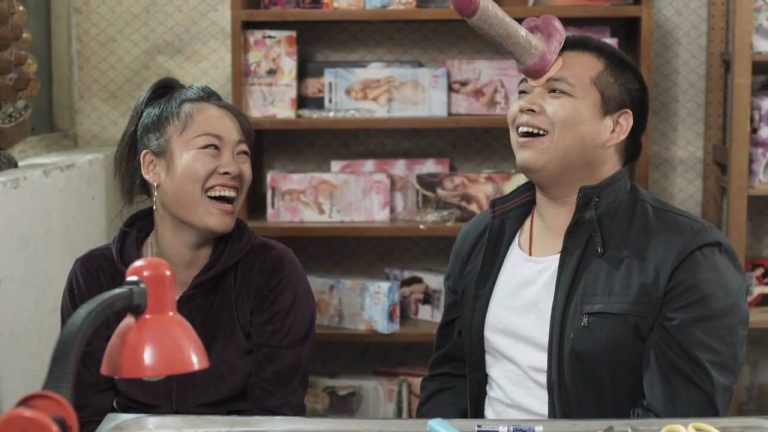
I was surprised at how much fun people had actually. The crew had a great time doing crazy things with the toys between takes, and then everyone involved wanted their own toy as a memento when we wrapped shooting. But then some of the crew didn’t want to choose their toys in front of everyone else, so they waited until no one could see them before choosing. I think this is a good example of how attitudes are changing. Even outside the set we’d often have pedestrians just peering into the windows. Zhao Jun, our lead actor, even took one of the toys, stuck it to his head like he does in the film’s trailer, and stood out in the hutong, a giant dildo stuck to his head. Construction workers stopped what they were doing and came over to have a look. That was a real hit, it definitely made their day.

I’ve seen you love Michel Gondry and Stanley Kubrick movies. Did they influence you?
You know it’s interesting, I think both directors shoot really great comedies. That may seem strange to say of Kubrick, who’s associated with more confronting material. But so many of Kubrick’s films are at heart absurd and dark comedies. But I enjoy both directors’ work because they really do push the boundaries with each of their films. And I think that’s really the goal of anybody who does art, to try to push the envelope, if only just a little. Otherwise we’re just in a cycle of constant repetition and regurgitation.

Was it difficult to direct a film in Chinese Mandarin?
Absolutely! Directing in English is hard enough, but in Mandarin it was three times as difficult. You lose a lot of the subtleties when it’s not your first language. Like the word “smirk”, I may want to use that word to an actor. Now that word has a real flavour to it in English, but how do I say that in Chinese and still retain the humour? I had a great crew to not only give me support, but who were able to add a lot of the local humour to the film. I’ve found there’s no better way to improve on my Chinese language skills than in a local sex shop with forty cast and crew.

How the Chinese attitude toward sex is changed in the last decades?
Well, when I came here in the 80’s it was a different kettle of fish. Even though I was a boy, I remember that couples didn’t really hold hands outside much, many pedestrians still wore grey socialist outfits, and the most risque foreign movies playing in the cinema were films like “Cannonball Run” with Burt Reynolds. But stuff was changing. I remember seeing Cui Jian play at Maxim’s in the late ’80s, and then some really radical art started emerging, my parents took me to some of those. Then of course in the early ’90s, the adult shops got approved to open. I think that change in China is pretty evident everywhere really. A friend of mine was in a Beijing cab the other day and his driver suddenly turned to him and started saying all these sexually explicit terms in English, really bad swear words. Where did he learn this stuff? On TV? I don’t think so.

Do you think the movie will be well received by the Chinese audience?
I was in a Beijing sound editing studio yesterday, making changes to the film’s sound. Before long all the technicians came in to watch. They were young graduates from the Beijing Film Academy. They sat down on the couches, just relaxing, laughing, enjoying themselves basically. As a director, that’s pretty much all you can ask for, after all the hard years of work, that total stranger can relate to what you’re saying and understand the humor.
Interview with Melanie Ansley, “Red Light Revolution” producer

Did you find many difficulties in order to get permission to shoot the movie?
In China it’s not shooting the movie that’s difficult, it’s getting it screened once you’ve shot it. We found most locations very willing to cooperate, and very few people were concerned about whether we had a screening permit or not. So in many respects, the system isn’t geared to stop you from shooting what you want, rather it’s the fact that distribution is so tightly controlled that deters many filmmakers. That said, there’s definitely more than one way to get something done here, you have to think creatively about what you have and who you know, and decide which door to knock on–sometimes it’s not the most obvious one.
In China, isn’t really easy to shoot an independent movie. Was it difficult to pitch the project and get a proper budget?
In some ways, it’s actually easier to shoot an independent movie in China–in our case for two reasons. One, there’s no government subsidy or film funding body here, so right off the bat, you’re not expecting to walk the road of making applications and waiting for results. You know that you’re going to have to go private, whether that’s through selling a kidney or finding sponsor companies. So that forces you to act faster because you aren’t having to schedule in 6 months of waiting for funding decisions.
Second, we had an advantage that we were shooting on a RED camera, and RED hadn’t yet become widely used in Chinese independent film circles; even now there are very few mainstream directors here working in the RED. This meant that we had a lot of people willing to work with us who would have otherwise not been involved, just because they wanted to gain some hands-on experience with these new cameras. I’m not sure we would have had the same draw elsewhere since it seems everyone is shooting on RED nowadays.
The movie will be distributed in China?
Though nothing’s certain in filmmaking, I can’t see the “Red Light Revolution” not being distributed in China in some way, shape, or form. Especially as China invests its movies through non-traditional media like the internet much more than we do in the West. I have been asked repeatedly by Chinese viewers who’ve come across the teaser when they can see it in cinemas, and I’m currently talking with a few mainland producers about that possibility.
Someone once asked me, “Is China ready for this movie?” I think Chinese audiences are definitely more than ready for this movie, it’s whether the bureaucracy is ready that’s the question. I won’t deny it’s a challenge, given some of the local requirements, but I believe a little bit of creative thinking gets you far, and maybe we’ll even come up with a new method of distributing movies here along the way.
Interview: Matteo Damiani
Links: Facebook Fan page, Sam Voutas Blog


