Every year, in Rongshui Miao Autonomous County, Guangxi, not too far from Liuzhou, local people celebrate the Chinese New Year with the 500-year-old tradition of horse fighting.
The rule is simple: two male horses fight against each other in a fight over a female. Over the years, fights become an important income for locals, attracting tourists from every part of China and criticism from the animal rights group.
Chinese New Year, Chunjie, is approaching fast and hundred of millions of people are moving in China. Many people just try to go home, while … Read more
Overloaded Peking is a documentary about Beijing and the Chinese modernization we did in 2001 (MDDM, abelvideo).
It features a long and interesting interview (15:32) with a young Jia Zhangke about cinema, changes in the young Chinese generations, modernization of the country, the internet, censorship, and much more.
In 2001, Jia Zhangke movies (along with many other Chinese directors’ works) were forbidden in China. Eventually, Jia Zhangke emerged as one of the most famous new Chinese directors. In the documentary appears also Zhao Tao (during Jia Zhangke’s interview) and Dj Gaohu. Please view the documentary at 480p, otherwise, the subtitles will be unreadable.
A couple from Hunan annually recycles something like 9 million plastic bottles a year to send their kids to the university. Every day, for 10 … Read more
The Consequences of Blending Science and Superstition in Qigong
In the aftermath of the Gang of Four’s collapse, Qigong emerged as a means for China to rediscover its cultural identity, which had been severely tested by the Cultural Revolution’s catastrophic effects on the nation’s cultural and relational systems.
Seeking a unique path toward modernization, China attempted to fast-track scientific progress by blending unconventional science with superstition, ultimately leading to bizarre and damaging consequences in the long term.
From the late 1970s to the early 1990s, Qigong served as the focal point of China’s exploration into the boundaries of human potential through the development of extraordinary abilities (known as teyigongneng in Chinese). The Chinese government invested significant resources into various Qigong practitioners and self-proclaimed gurus, who capitalized on popular beliefs and an underdeveloped scientific community to advance a plethora of imaginative ideas, seminars, therapies, hospitals, clinics, and even peculiar military experiments.
China was wholly consumed by the Qigong craze until it was abruptly quashed. Nevertheless, before the ultimate tragedy of the Falun Gong—China’s most popular Qigong school until 1999—the history of these movements is marked by a series of eccentric episodes. In October 1999, the Chinese government declared Falun Gong a “heretical organization” that posed a threat to social stability.
Making money writing health books it’s easy in China, especially if you’re a celebrity …
The 80s
In the ’80s and early ’90s Qigong presentations took place in front of a delirious audience. Beijing. People collectively preachingBeijing Beidahe, January 2, 1981. Zhan Zhuang postureIn 1981, China established the Chinese Qigong Science Research Council, qigong fever began to spread throughout the country. In the picture, a Qigong Troupe visited Britain.
1986
October 7th, 1986. Chinese Antarctic expedition team members practicing QigongDuring the winter of 1989, Ditan Park in Beijing was a favorite place to practice Qigong. At that time other mystical beliefs were combined with the practice of Qigong. Buddhist Lohan GongWinter 1989. Qigong transformed itself from martial art to spiritual treatment of incurable diseasesAcupuncture treatment for Bulgarian ambassador performed by Zhu Heting. He claimed to treat diabetes, Parkinson’s disease, paralysis, cancer, and cataracts.1989, August 31st. A six years old kid practicing qigong to lose weight1989, January 5th. A Qigong master in a Beijing hotel treating an American English teacher
Weird Science
Qigong Science Research Association of Guangdong Province developed the “Electronic Qigong Master”. Allegedly treated cervical hypertrophy, muscle strain, arthritis, headaches, palpitations, myopia, insomnia, and other 20 kinds of diseases.1986, November 15th. In Sichuan, local scientists developed a system to mimic the process of qigong practice1987, April 7th. Qigong began to be uncontrollable. Magic and science started to go hand in hand. Shanghai Institute of Chinese Medicine practiced anesthesia to patients for surgery with qigong1987, January 10th. A qigong master treats patients using qigong hypnosis1987, November 30th. All the ordinary magic tricks began to be used by qigong masters in order to demonstrate their powers: swallowing glass, curving spoon, mind control, instant healing, etc.1992, December 28th. Chinese dragon magic.1992, Harbin. In this period the blockbuster books were Qigong manuals.1995, May 24th. Liaoning Province Qigong Medical Association. Qigong has begun to replace traditional medical treatment with qigong1995, May 24th. Li Zhenghong teaching qigong rehabilitation for diabetes.
Zhang Xiangyu
Miaofengshan Advanced Qigong training, Beijing. The pot on the head should converge the universe force to strengthen the telepathy
In 1990, a woman master of Qi Gong, Zhang Xiangyu, pushed its influence to a peak with her performance in Beijing. Millions of “pilgrims” gathered from several provinces to see her and caused great traffic jams. When Zhang waved her hand out of a window of the third floor of the hotel, the “pilgrims” in the street cheered. Zhang claimed that she could talk with extraterrestrial beings and was able to cure every disease. She treated her patients with methods similar to those of witchcraft and demanded large amounts of money from them. Many patients became ill under her treatment and some of them died. In August, Zhang was arrested and accused of cheating. The exposition of her swindle weakened the cult of Qi Gong. Zhang was convicted in 1993 (from Paranormal in China, Wu Xianghong, March 1995, Csicop.org)
Wang Lin
Wang Lin, is a phony Qigong master, became famous for Qigong in the 1990s and he has been exposed by Beijing News in July 2013. Then, he fled to Hong Kong and he claimed to be the Chinese Snowden. He has been charged with Illegal medicine practice, bigamy, fraud, tax evasion, bribery, gambling, and illegal possession of firearms.
Pang Ming
Pang Ming (aka Pang Minghe) developed a medical system called Wisdom Healing Qigong (Zhineng Qigong, 智能气功) during late 1970. It was a synthesis of many supposed ancient lineages of Chinese healing practices.
Zhineng Qigong Instant Healing
Sun Chulin
Sun Chulin claimed to be able to change shape to materials with the power of the mind. She was considered by many as a living proof of the existence of SA. According to many Chinese sites, she was capable of accelerating the biological development of organisms by thousands of times.
The second part of the video is interestingly enough: Sun engaged in a sort of mystical ecstasy to grow a seed.
Qigong Master: Demonstration Of Power
The supernatural powers of Zhang Baosheng (arrested for fraud in 1995) <>
Jinyun Mountain Taoist Association had 30,000 followers, including business tycoon Jack Ma, the founder of Chinese e-commerce firm alibaba.com, and pop singer Faye Wong. The aim is to restore kidney functions through massage. Li Yi, the founder of the Jinyun Mountain Taoist Association had been the focus of a police probe over an allegation of raping a college student. Li is the latest “grandmaster” exposed as a fraud
Abbot Lee Shao-Long Li of Jinyun Mountain Taoist Association during a lecturing. This year its supposed magical properties have been questioned and were accused of fraud
Zhang Wuben, a once-popular Chinese diet therapist, was found by officials in May to have faked his nutritionist qualifications
Making money writing health books it’s easy in China, especially if you’re a celebrity …
Chinanews – On January 22, Yunnan forest rangers cracked down on the illegal trading of tigers and other local protected animals. They sized as many … Read more
How Eunuchs were made A eunuch in ancient China was a man castrated, typically early enough in his childhood to have major hormonal consequences in … Read more
Every year, hundreds of millions of migrant workers go back to their hometowns to celebrate the Chinese New Year Festival.
Trains are packed to capacity and trip conditions are scarcely bearable. Sometimes the travel to home can last two days. China expects 3.6 Bln Trips Over Lunar New Year.
Images of train trips in China during the Chinese New Year
Getu-River National Park in Guizhou Province, not far from Anshun is dotted by hundreds of mountains eroded by the force of water and wind. In a large cave live today 18 people (in 2007 they were about one hundred), all of the Miao ethnic minority group.
The villagers of Tajing have lived here for centuries. The largest cave is approximately 230 meters long, 115 wide, and 50 high. In China, they became famous after a China Daily article in 2007, which depicted them as modern troglodytes. Other articles claimed they were the last tribe who lived in a cave in Asia (but that’s not true). They have developed into a quasi-tribal society. Inside the cave, there are many houses, all without a roof, a school, and a basketball court. Most of the people left the village in search of money and job opportunities. However, many others refused to leave the village and even refused new houses built by the local government. In Southwest China, there is also another village in a cave, Fengyandong, in Yunnan province.
The new houses built by the government and refused by the villagers
Chinese Communist locomotives In 1946, the Manzhouli railway station, located in Inner Mongolia on the main rail line to Harbin, became notable for an event … Read more
Unit 731 (731部隊) led by Japanese microbiologist Shiro Ishii, was a covert biological warfare research and development unit of the Imperial Japanese Army that undertook … Read more
Our travel magazine “Chine Magazine”debuts in France, finally! You will find the magazine in all news-stands in France and in the major luxury hotels from … Read more
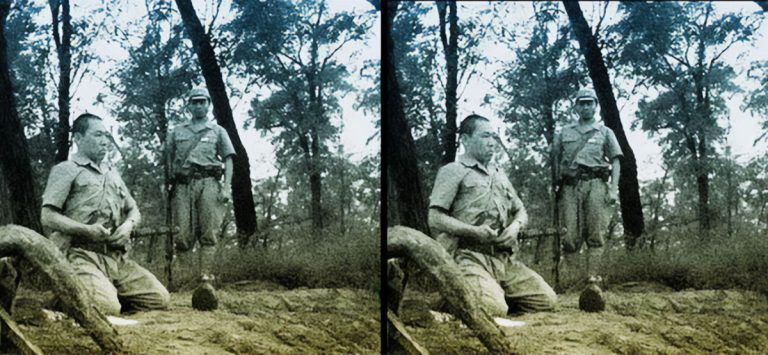
Following Japan’s surrender in World War II, a number of high-ranking military officers committed seppuku (腹切, hara-kiri, “stomach-cutting”). Seppuku, a ritual suicide by disembowelment, was … Read more
This website uses cookies to improve your experience. We'll assume you're ok with this, but you can opt-out if you wish.AcceptRejectRead More
Privacy & Cookies Policy
Privacy Overview
This website uses cookies to improve your experience while you navigate through the website. Out of these, the cookies that are categorized as necessary are stored on your browser as they are essential for the working of basic functionalities of the website. We also use third-party cookies that help us analyze and understand how you use this website. These cookies will be stored in your browser only with your consent. You also have the option to opt-out of these cookies. But opting out of some of these cookies may affect your browsing experience.
Necessary cookies are absolutely essential for the website to function properly. This category only includes cookies that ensures basic functionalities and security features of the website. These cookies do not store any personal information.
Any cookies that may not be particularly necessary for the website to function and is used specifically to collect user personal data via analytics, ads, other embedded contents are termed as non-necessary cookies. It is mandatory to procure user consent prior to running these cookies on your website.