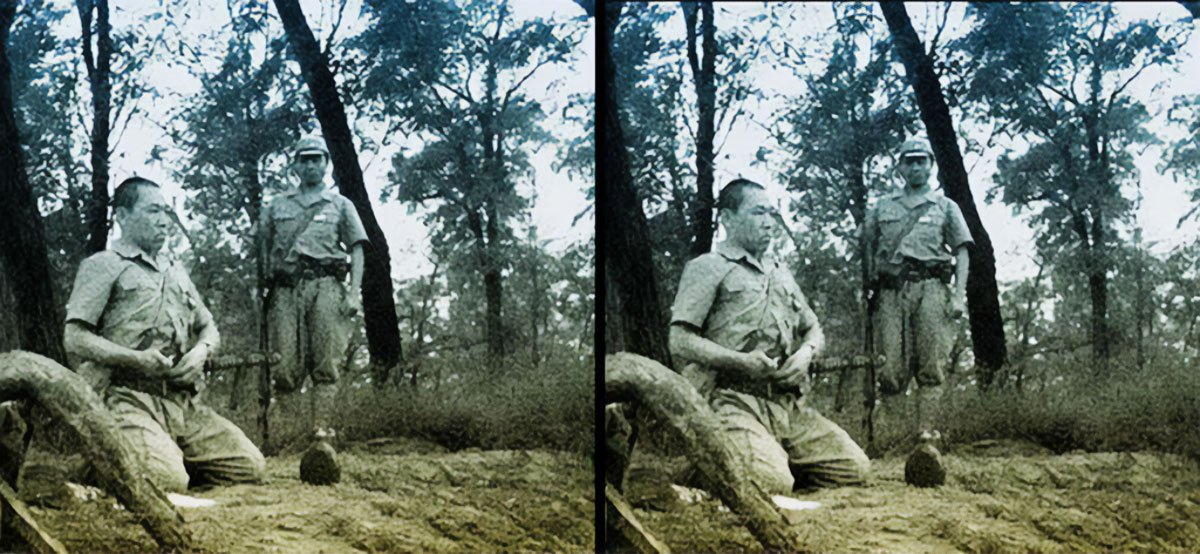
Following Japan’s surrender in World War II, a number of high-ranking military officers committed seppuku (腹切, hara-kiri, “stomach-cutting”). Seppuku, a ritual suicide by disembowelment, was a practice steeped in Japanese history and the samurai code of honor. It was seen as a way to preserve one’s honor in the face of defeat or disgrace.
These officers chose seppuku over surrender for a complex set of reasons. Ideals of loyalty, duty, and the concept of “bushido” (武士道, the way of the warrior) likely influenced their decisions. The wartime propaganda machine in Japan had also heavily emphasized the concept of a glorious death over surrender.
The act of seppuku itself involved a specific ritual. Traditionally, a wakizashi (脇差し), a short sword typically 30 to 60 cm in length, would be used to inflict a mortal wound on oneself by disemboweling the abdomen from left to right. However, due to the nature of the wound, seppuku was rarely immediately fatal. Therefore, a kaishakunin (介錯人), a designated second person, would be present to decapitate the participant, ensuring a swift and relatively painless death.
Related articles: The Unit 731 in China
Suppuku images


Post Author

1 thought on “Japanese officer performing seppuku during World War II”