Sin-ying Ho ceramic explores themes of migration, identity, globalization, and cross-cultural exchange.
Sin-ying Ho is a contemporary ceramic artist internationally recognized for her innovative reinterpretations of Chinese porcelain of the past, merging the refined aesthetics of traditional ware with contemporary imagery, political symbolism, and global cultural references. Her artworks are quite intimate and centre on the contradictions in her life; it discusses migration, transplanting, and growing up in a colony like Hong Kong, which causes a sense of dislocation and necessitates ongoing identity negotiation. Understanding her paradox, she realises that it is a phenomenon not only for her but it also affects all planets. So she reflects how cultural borrowings and connections in an accelerating “global village” are impacted by globalization. She felt compelled to produce a body of artwork in 2001 that was centered on conveying and characterizing the collision path of Eastern and Western cultures. New vs old, technology versus tradition, communication versus language, aesthetics versus cultural identity, and economy versus power are all part of the backdrop of this artwork.
In light of this, in the context of 21st-century economic globalization, symbols, signs, and corporate logos are used to re-contextualize the intersecting cultures of East and West, new and old. These specifics transcend time and geographical limits. She is also particularly interested in investigating the connection between ornamental symbols derived from Chinese porcelain export goods and the language of symbols in a dialogue with nowadays logos. Her artwork clearly presents porcelain as a living language that can address pressing issues of politics, identity, and global connection in the twenty-first century rather than as a relic of the past. Her artwork also challenges the observer to think about whether human pursuits have any discernible patterns or significance. In addition to her studio art and creative practice, she is an educator and advocate for ceramics as a critical medium within contemporary art discourse. She has an impressive exhibition record. The Hood Museum of Art in New Hampshire, the Fidelity Investments in Boston, the Icheon World Ceramic Center in Korea, the Glenbow Museum in Canada, the Yingge Ceramics Museum in Taiwan, and the Canadian Consulate General in Hong Kong all include her works in their permanent collections. The cover of Utopic Impulses: Contemporary Ceramics Practice, edited by Ruth Chambers, Amy Gogarty, and Mireille Perron (Ronsdale Press 2007), features her piece, Music. Ho is on the advisory boards of the Watershed Center of Ceramics Art and the Taoxichuan Art Center in Jingdezhen, PRChina. She currently resides in New York City.
Queens College | Official site | Instagram | Facebook
Sin-ying Ho ceramic explores themes of migration, identity, globalization, and cross-cultural exchange.
Sin-ying Ho is a contemporary ceramic artist internationally recognized for her innovative reinterpretations of Chinese porcelain of the past, merging the refined aesthetics of traditional ware with contemporary imagery, political symbolism, and global cultural references. Her artworks are quite intimate and centre on the contradictions in her life; it discusses migration, transplanting, and growing up in a colony like Hong Kong, which causes a sense of dislocation and necessitates ongoing identity negotiation. Understanding her paradox, she realises that it is a phenomenon not only for her but it also affects all planets. So she reflects how cultural borrowings and connections in an accelerating “global village” are impacted by globalization. She felt compelled to produce a body of artwork in 2001 that was centered on conveying and characterizing the collision path of Eastern and Western cultures. New vs old, technology versus tradition, communication versus language, aesthetics versus cultural identity, and economy versus power are all part of the backdrop of this artwork. In light of this, in the context of 21st-century economic globalization, symbols, signs, and corporate logos are used to re-contextualize the intersecting cultures of East and West, new and old. These specifics transcend time and geographical limits. She is also particularly interested in investigating the connection between ornamental symbols derived from Chinese porcelain export goods and the language of symbols in a dialogue with nowadays logos.
Her artwork clearly presents porcelain as a living language that can address pressing issues of politics, identity, and global connection in the twenty-first century rather than as a relic of the past. Her artwork also challenges the observer to think about whether human pursuits have any discernible patterns or significance. In addition to her studio art and creative practice, she is an educator and advocate for ceramics as a critical medium within contemporary art discourse. She has an impressive exhibition record. The Hood Museum of Art in New Hampshire, the Fidelity Investments in Boston, the Icheon World Ceramic Center in Korea, the Glenbow Museum in Canada, the Yingge Ceramics Museum in Taiwan, and the Canadian Consulate General in Hong Kong all include her works in their permanent collections. The cover of Utopic Impulses: Contemporary Ceramics Practice, edited by Ruth Chambers, Amy Gogarty, and Mireille Perron (Ronsdale Press 2007), features her piece, Music. Ho is on the advisory boards of the Watershed Center of Ceramics Art and the Taoxichuan Art Center in Jingdezhen, PRChina. She currently resides in New York City.
In the hands of Sin-ying Ho, porcelain is far more than a medium; it is a complex language of history, migration, and the modern digital age.
What inspired you to pursue a career as a ceramic artist, and how did your artistic journey begin?
My artistic journey began in Hong Kong during the 1970s and 80s, a time shaped by British colonial influence, where daily life, language, and identity were constantly negotiated. Cantonese was my mother tongue, yet I was required to learn English and even adopt an English name. That early duality planted the seeds of a lifelong awareness of cultural displacement—though I didn’t have the language for it then. As a child, I remember eating rice from a porcelain bowl and wondering how such an object came into being. I had no idea that porcelain would one day become central to my life, but that curiosity stayed with me. In the late 1980s, I visited my friend Ms. Li Yu Fun at the Pottery Workshop in Hong Kong. She handed me a ball of clay, and I sat at the potter’s wheel for the first time. I giggled, laughed, and didn’t want to stop. Soon after, I began taking classes at the Fringe Club, where the Pottery Workshop was located. At the time, I was a fulltime stage actress with the Chung Ying Theatre Company, so my schedule was unpredictable. Ms. Li introduced me to Mr. Edward Yu, who generously gave me a key to his Earthling Studio and allowed me to practice anytime. Those four years of practice laid the foundation for my future as a ceramic artist. When I immigrated to Canada in 1992—initially to pursue acting—I encountered a new kind of dislocation. It was at Sheridan College that I rediscovered clay.
Ceramics offered a language beyond words, one capable of expressing the tensions between cultures, histories, and identities. A pivotal turning point came in 1996, during my BFA studies at the Nova Scotia College of Art and Design, when I participated in an offcampus study program at the Jingdezhen Ceramics Institute in Jiangxi Province. Living and learning in the heart of the “porcelain city” profoundly shaped both my technique and philosophy. Immersed in Jingdezhen’s centuries-old ceramic traditions, I began to synthesize traditional and contemporary aesthetics while navigating the cultural contrasts between Eastern and Western education systems. In 1998, I served as interpreter and liaison for a group of 60 ceramic artists, educators, critics, and collectors from the United States, Canada, England, and New Zealand on a tour of major ceramic centers including Yixing, Jingdezhen, and Yuzhou, as well as cultural hubs such as Shanghai, Xi’an, and Beijing. Acting as a bridge between East and West deepened my contemplation of linguistic and visual language—particularly how signs, symbols, and iconography shift across cultures. These experiences solidified my commitment to porcelain as my primary medium and set the trajectory for my career.
Her vessels carry and discuss the fragility of identity, the power of the silhouette, and how she breathes new life into a 2,000-year-old tradition.

How long did it take you to develop your skills? Did you encounter challenges that made you question your path?
Ceramics is a lifelong practice—one of continual discovery. My training across Canada, the United States, and China immersed me in diverse approaches: Eastern and Western, traditional and conceptual. Porcelain, in particular, demanded years of discipline. It is technically unforgiving, historically charged, and conceptually rich. My time at the Jingdezhen Ceramics Institute was especially formative, exposing me to centuries-old techniques and philosophies that continue to inform my work.
There were moments of doubt, especially during periods of migration and during the early years of learning porcelain’s complexities. I remember building and painting a three-foot-tall vessel for months, only to have the shoulder collapse during the glaze firing. Another time, I applied terra sigillata to a bone dry vessel already covered with intricate imagery. Instead of forming the smooth, glossy surface I expected, the terra sigillata cracked into a spiderweb pattern. I cried for a week before deciding to rub red terra sigillata into the cracks to enhance the unexpected pattern. The result was an irresistible surface. These experiences taught me one of the most important lessons in ceramics—and in life: transformation often emerges from failure. Turning disaster into possibility has become central to both my practice and my philosophy. Teaching has also been integral to my development. Over the years, I have taught ceramics at Southeastern Louisiana University, the Emily Carr Institute of Art and Design, the Alberta College of Art & Design, and Concordia University, and have served as a Visiting Artist at Harvard University and the Hong Kong Art School. I am currently an Associate Professor of Ceramics at Queens College, City University of New York. Teaching deepens my understanding of the material and continually renews my dedication to the field.
Ceramic transmits daintiness and fragility but also solidity and protection. What is your relationship with the material? What did you feel after finishing your first creation?
Ceramic embodies the very contradictions that shape my life: fragility and resilience, vulnerability and endurance, tradition and innovation. When I completed my first porcelain piece, I felt an unexpected sense of recognition—as if the material understood something about me before I could articulate it myself. Porcelain carries a long history of global exchange, empire, and desire. It is delicate in process yet capable of surviving for millennia. That paradox mirrors my own experience of navigating multiple cultures and identities, and it continues to guide my relationship with the material.
Porcelain carries deep historical associations with trade, empire, and power, and Sin-ying Ho’s artwork serves as a high-contrast mirror to our globalized world.

Porcelain is notoriously fragile during the firing process, but lasts millennia once finished. Does the risk of failure affect how you value the final piece?
Absolutely. The kiln is a space of uncertainty—porcelain can crack, warp, blister, or collapse without warning. That vulnerability heightens the significance of each finished piece. For me, the firing process becomes a metaphor for cultural identity: shaped by pressure, unpredictability, and transformation. The risk of failure is not something I try to avoid; it is integral to the meaning embedded in the object. Each piece carries the memory of that risk, and its survival becomes part of its story.
Her artwork asks a hauntingly important question: In a world of constant movement and digital noise, what pieces of our heritage do we choose to keep, and what do we allow to be overwritten?
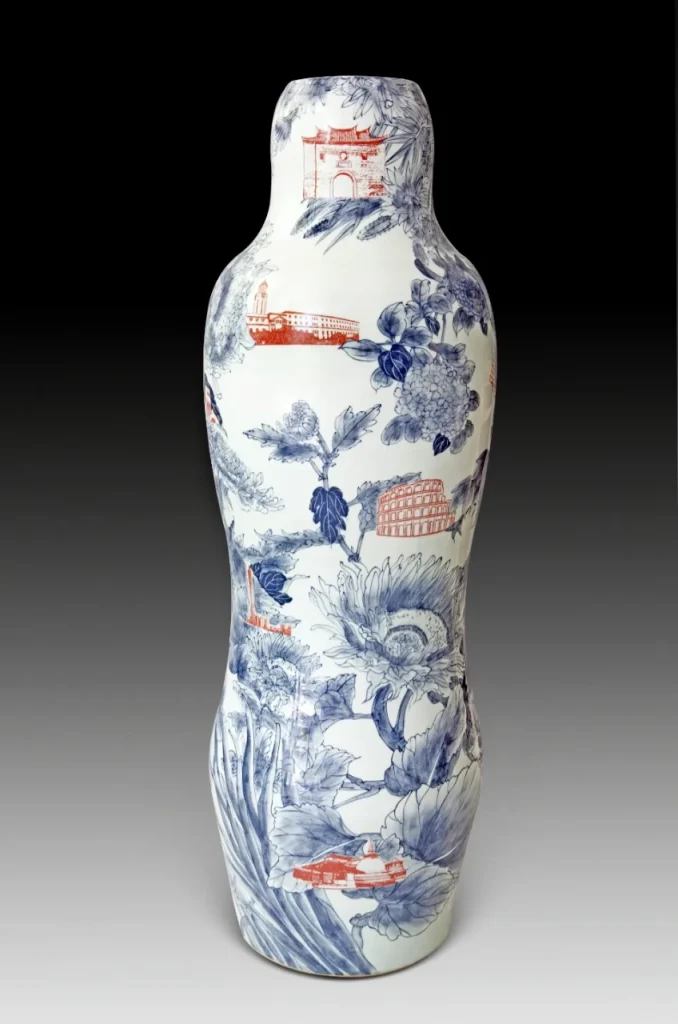
Many of your artworks reinterpret Qing dynasty porcelain aesthetics. How consciously do you engage with histories of trade, empire, and power?
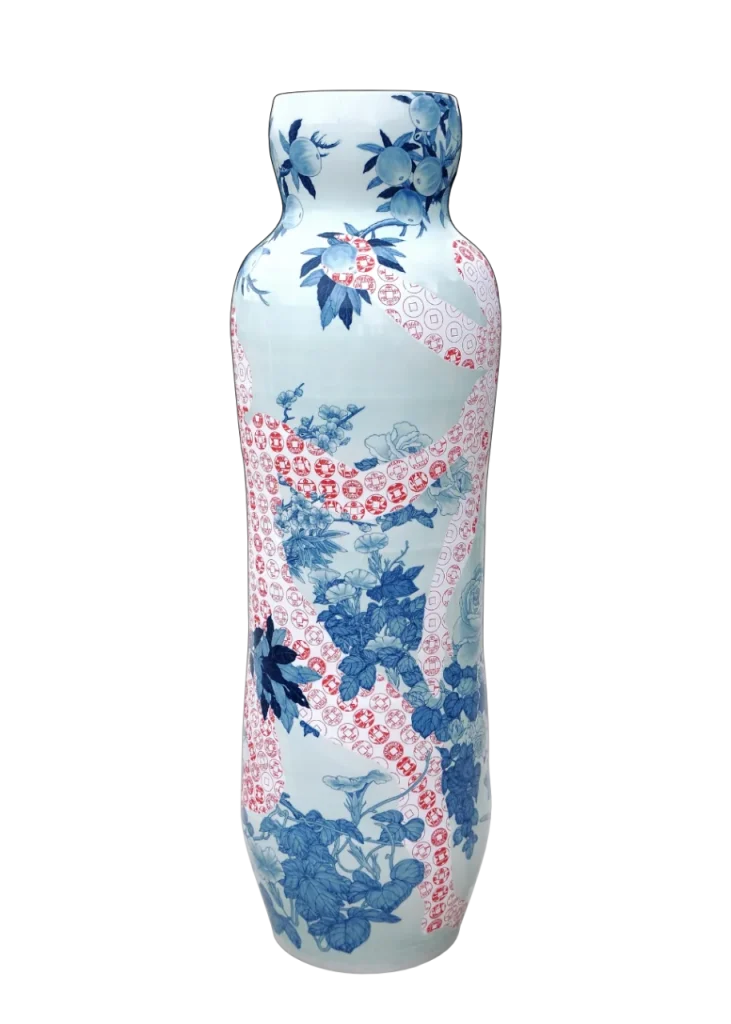
Very consciously. Qing dynasty export porcelain is deeply tied to global trade, colonial desire, and imperial power structures. As someone who grew up in a British colony, trained in Canada and the United States, and studied in Jingdezhen, these histories are personal. In Future Is in Our Hands (2008), I used the traditional doublegourd form associated with Daoism and immortality, but layered it with “@” symbols, children playing video games, and global digital imagery. In Temptation: Life of Goods, Adam and Eve are filled with Chinese coins—symbols of prosperity—but the coins are overlaid with corporate logos like CocaCola, Nike, Piaget, and Chanel. A jagged gold line referencing the 2008 stock market crash cuts across the surface. These juxtapositions reveal how global capitalism reshapes ancient symbols and human desires.

Your surfaces are richly layered and technically complex. You incorporate political symbols, maps, and national emblems. What do you hope future audiences understand about this era through your artwork?
I hope future audiences see this era as one defined by rapid globalization, technological acceleration, and cultural entanglement. The symbols I use—binary code, stock market charts, virus imagery, 5G cloud forms, corporate logos—are the visual vocabulary of our time. In World Garden (2014), peonies—symbols of wealth and royalty—surround global monuments such as the Coliseum, Taj Mahal, London Bridge, and Yellow Crane Pagoda. These combinations form a coded language, much like a computer system, that records the cultural collisions of our time. In One World, Many People, the title phrase appears in multiple languages, surrounded by flowers and figures glazed in celadon and yellow. The work imagines a utopian global garden while acknowledging the complexities of multicultural coexistence. My work becomes a kind of archaeological record of the 21st century.
The conflict between upholding tradition and accepting modernity is explicitly addressed by her artwork, which acts as a visual junction of traditional craftsmanship and modern, fast-paced global society.
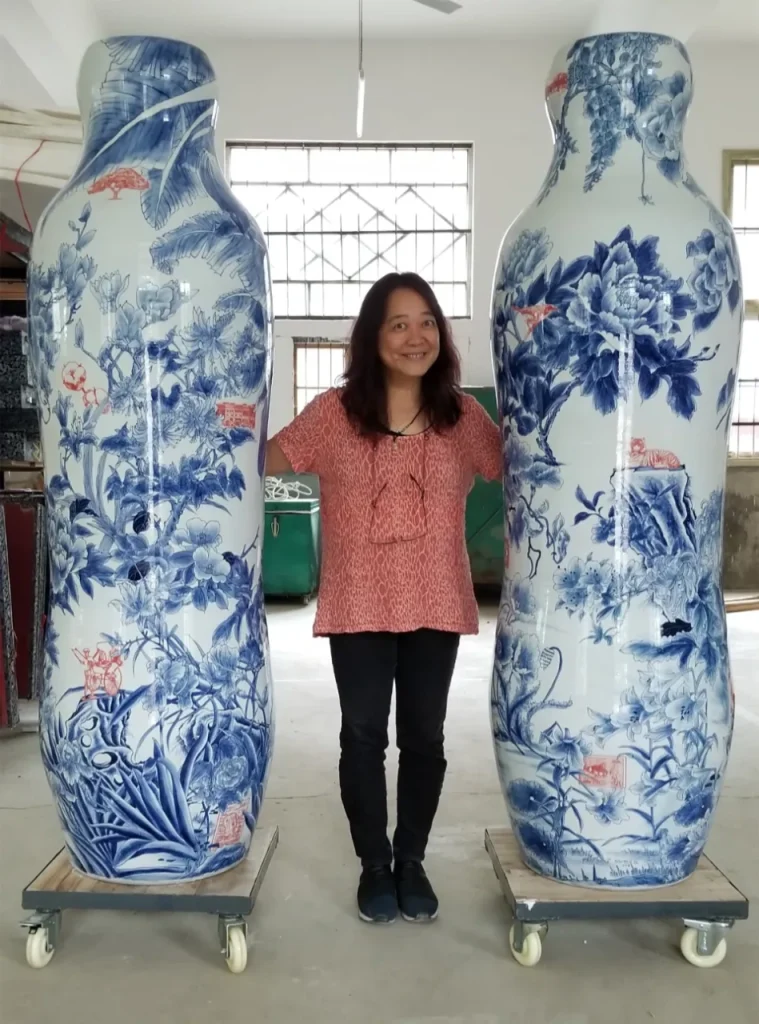
Can you share a story about a piece where experimentation led to an unexpected breakthrough?
A major breakthrough came when I began experimenting with multipart molds created through wheel throwing, cutting, and reassembling forms. Instead of hiding the seams, I left the evidence of extraction and reconstruction visible.
Works like Wedlock (2004) and Histogram No. 2 (2007) use bifurcated forms—one side crackled red, the other cobalt blue—to explore marriage, identity, and cultural codes. The red side references Chinese wedding imagery, while the blue side incorporates Qing dynasty inscriptions and European factory marks. This experiment opened an entirely new direction in my practice, allowing the form itself to embody cultural collision.

– Having lived and worked across Asia, Canada, and the United States, how has getting involved in different cultures shaped your visual vocabulary and the way you construct your vessels?
Each place I have lived—Hong Kong, Canada, the United States, and China—has contributed a distinct layer to my visual vocabulary. Hong Kong taught me about cultural hybridity and linguistic duality. Canada introduced me to multiculturalism and the North American studio pottery tradition. The United States exposed me to conceptual art and political discourse. Jingdezhen grounded me in the lineage of porcelain itself. I now see myself as a “global sapien.” I live and work in multicultural cities like New York, Toronto, and Hong Kong, and I maintain a studio in Jingdezhen. My life is a universal existence among many cultures and languages. These experiences shape not only the imagery I use but also the physical construction of my vessels. The forms often embody fragmentation, hybridity, and reconstruction, reflecting the lived reality of crossing borders both physically and psychologically. My international teaching career—from Harvard University and the Hong Kong Art School to Emily Carr, ACAD, Concordia, and Southeastern Louisiana University—has further expanded my understanding of how culture shapes artistic language. I now teach ceramics as an Associate Professor at Queens College, CUNY, continuing this dialogue with new generations of artists.
Many of your pieces bring to mind imperial porcelain. What does it mean for you to intervene in forms once tied to patriarchal power structures? If your vessels could speak on International Women’s Day, what would they say?
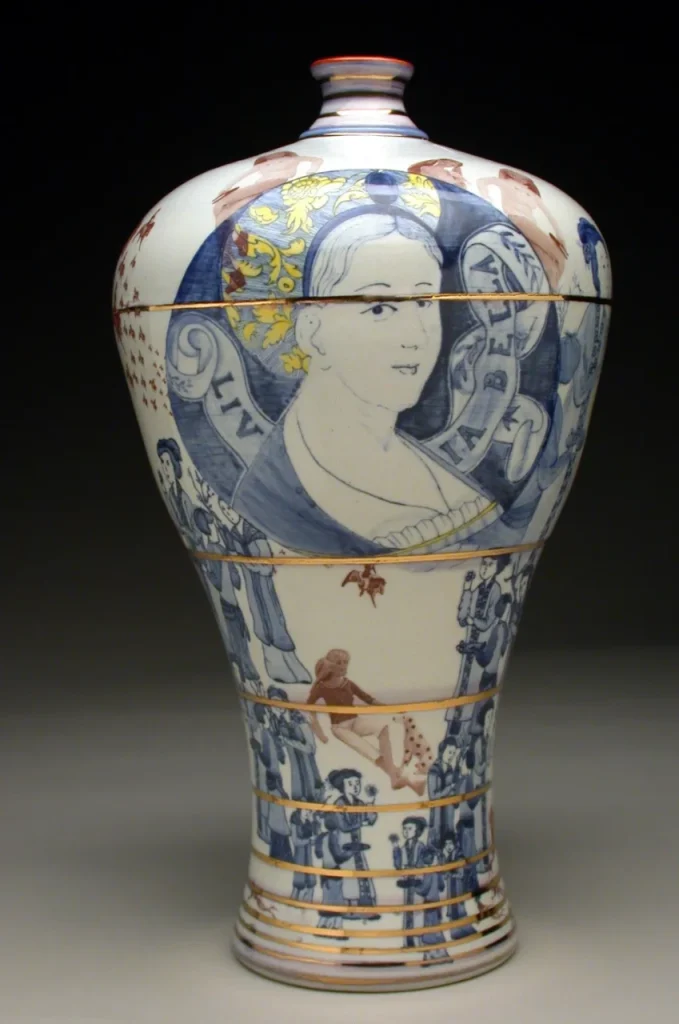
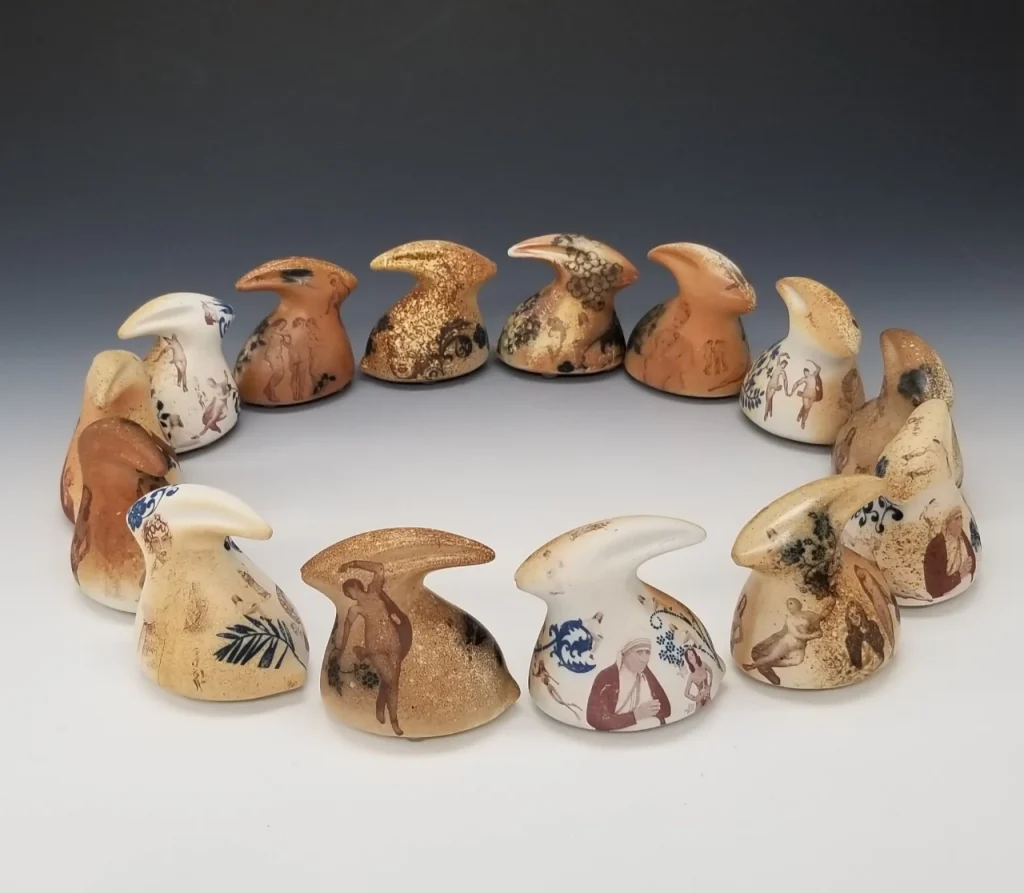
Intervening in imperial forms allows me to reclaim and reinterpret objects historically associated with hierarchy, patriarchy, and elite power. In my Graces series, I use the symbolism of the rabbit—gentle, vulnerable, yet resilient—to represent women across cultures. Each rabbit carries the image of a woman whose story transcends nationality, religion, or language. If my sculptures Seeing Eve, Bella, Ladies, ceramic panel Continuing Journey could speak on International Women’s Day, they would honor the strength found in vulnerability, the dignity in diversity, and the power of women’s stories across borders. They would assert that identity is not defined by imposed structures but by the courage to transform them.
Photos courtesy of Sin-ying Ho
Post Author