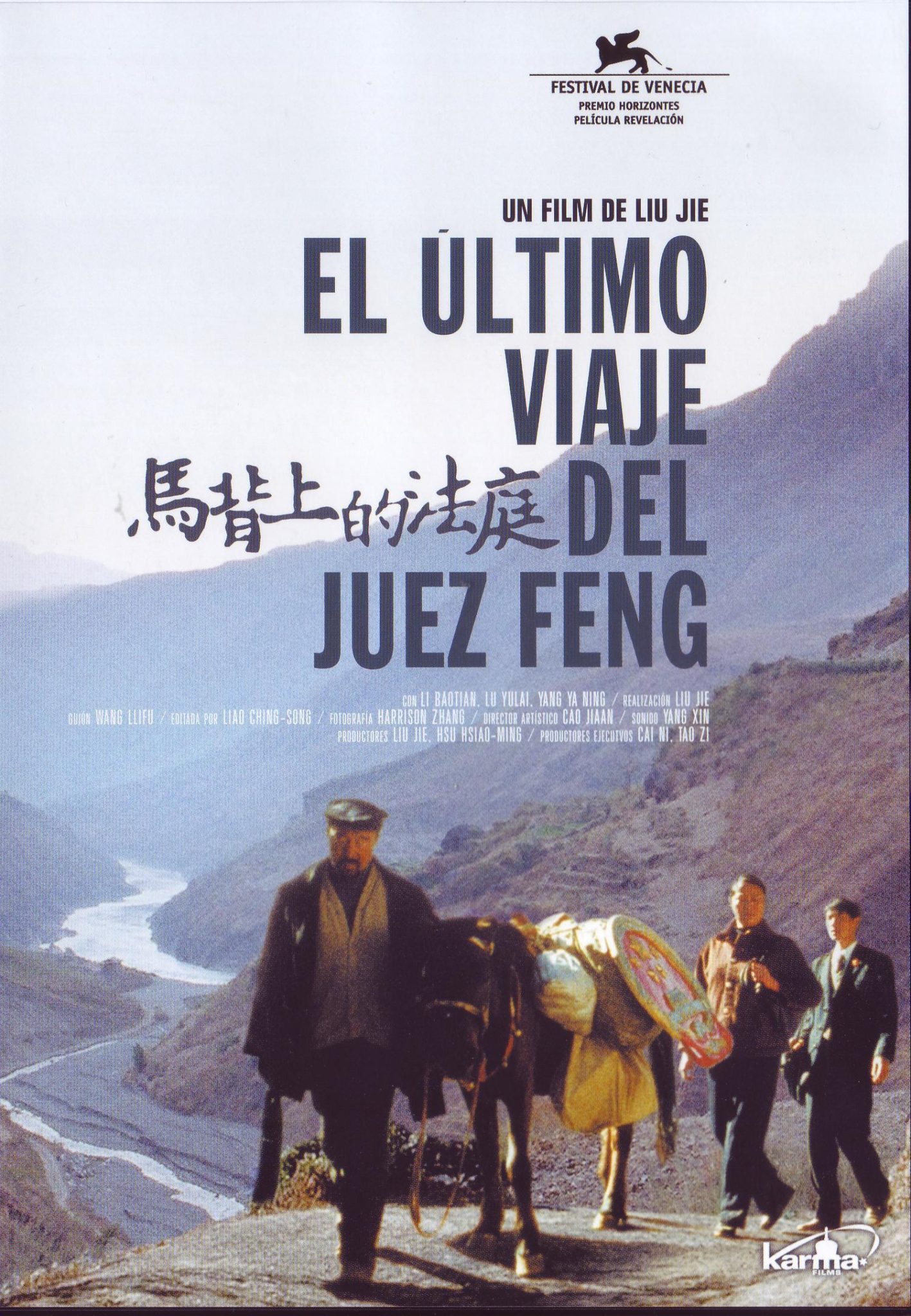

Courthouse on Horseback
- -The film follows three characters on a tour of the remote Yunman province of China where they travel with a horse to deal with legal disputes in mountain villages. Government policy is forcing the retirement of "Auntie" Yang (Yang Yaning) and she will have to separate after years of professional partnership from Feng (Li Baotian). They are accompanied by her replacement, recent law school graduate Ah-Luo (Lu Yulai).
Photos
Storyline
Details
Box Office
Company Credits
Technical Specs
The film follows three characters on a tour of the remote Yunman province of China where they travel with a horse to deal with legal disputes in mountain villages.
Government policy is forcing the retirement of “Auntie” Yang (Yang Yaning) and she will have to separate after years of professional partnership from Feng (Li Baotian). They are accompanied by her replacement, recent law school graduate Ah-Luo (Lu Yulai).
Courthouse on Horseback movie trailer
On the meandering red-earth path in Southwest China’s Yunnan Province, a traveling law court gets on a tour. Feng, who is in his mid-50s, is a seasoned judge; the court clerk Auntie Yang belongs to the Moso Ethnic Group and is retiring because of the changed personnel policy; Ah-Luo, a recent college graduate of Yi Ethnic Group, is on his very first tour of duty.
They share a companion in an old horse, which is carrying all the court facilities.
In a village of the Pumi ethnic people, Feng deals with a dispute around a grave dug up by pigs; after Ah-Luo loses the national emblem, the symbol of the state authority, at Moso people’s swamp, they have to seek help from the woman chief…
In the village where a wedding is awaiting Ah-Luo, an unexpected incident leads to a confrontation; after an argument with Feng, Ah-Luo runs away with his bride, giving up the career that he finds hopeless. Auntie Yang doesn’t finish the tour because of her early retirement; without the companion that he secretly loves, Feng has to continue the tour that becomes lonely and desperate…
Director’s notes
It was during my trip to Southwest China’s Yunnan province in 2003 that I first learned about the story. Following that, I had another six travels to Ninglang County in Yunnan.
Located in the mountains in the northwest of Yunnan, the Ninglang County is isolated from the outside by dangerous paths. Covering an area of about 6,000 square kilometer, the place is home to some 210,000 people, who belong to 12 ethnic minorities. At the end of 2004, over 190,000 local residents were still living on the annual income under an equivalent of 70 euros.
Here, a local ethnic minority named Moso is still retaining the primitive social structure of matriarchy.
As the director of Courthouse on the Horseback, I put the focus on the tour of duty of three court officials. Their experiences turn out to be a reflection of the status quo of China’s judicial system, the life in regions resided by ethnic minorities in China, the issues of ethnicity, culture, environment, development, religion, the clash between tradition and modernity, and most prominently, the public’s trust in the judicial system.
The national emblem carried by the horse is the exact image of the local judicial system, which is on a bumpy road of development.
Currently, there are nearly one thousand such mobile courthouses in China. The issue presented in the movie is quite common in China’s rural areas. The story is based on what actually happening in China in the 21st century.