Brushstrokes Without Filters: Liao Wan-ning’s Philosophy of Unembellished Truth
Xi’an-born oil painter Liao Wan-ning is renowned for her expressive color palette, and skill in transforming “invisible” feelings into concrete textures. In July 1998, she graduated with a Bachelor’s degree from the Second Studio of the Oil Painting Department at Xi’an Academy of Fine Arts (with a focus on Impressionist research). From 1999 to 2000, she pursued postgraduate studies at Xi’an Academy of Fine Arts, and in July 2001 she completed the Advanced Studies Program for Faculty at the same institution. From 2000 to 2006, she served as Art Director at a women’s general-interest magazine under the Shaanxi Provincial Press and Publication Bureau. In 2006, she signed with the Baoqutang Contemporary Art Gallery in Hong Kong. Upon the completion of her three-year contract, she held her first solo exhibition of oil paintings, and during this period participated in numerous domestic and international oil painting exhibitions, with works collected by private collectors and sold at auction on multiple occasions.
Liao’s approach chose to honor her own voice and concentrate on topics that truly captivate her, often elderly folks, folktales, and antiquated artifacts, capturing their nowaday looks and situations. She focuses on her specific philosophy regarding memory and the physical act of creation. Indeed Liao Wan-ning’s artworks are deeply tactile and have gained acclaim for their direct exploration of themes of memory, fragility and relational dynamics. In 2015, she established the Liao Wanning Art Space and became a professional artist dedicated full-time to artistic creation. She also launched fine arts training and education programs, guiding multiple middle and high school students into the preparatory and undergraduate programs of prestigious art academies both in China and abroad. In 2023, Liao Wanning settled in Canada, dedicating herself full-time to contemporary figurative art. She serves as a contracted mentor at a professional fine arts gallery and as a lecturer in art studies. She has passed the relevant assessments and holds memberships including: SCA (Society of Canadian Artists), APPL (American Professional Painters League), CPSA (Color Pencil Society of America, selected member), AAPL (American Artists Professional League), IGOR (International Guild of Realism, professional member), and the National Oil and Acrylic Painters Society. She has been interviewed and featured by contemporary art publications and outlets in Italy, France, the United Kingdom, Spain, the United States, Canada, Israel, Hong Kong, and etc … with her works widely published.
Can you briefly introduce yourself? When did you realize you wanted to be an artist? What prompted you to embark on the path of art?
I am a figurative painter recognized both domestically and internationally, whose works primarily focus on portraits and historical themes, earning praise from the art community and the public. I adhere to an artistic philosophy of sincerity, restraint, and realism, rejecting flashiness and the pursuit of trends, using delicate brushwork to reveal the truth of humanity and the pulse of the era. In my artistic career, my work The Spinning Wheel was selected for the National Themed Fine Arts Exhibition; the oil painting Daydream won the Silver Award in the 2023 INNOART PRIZE International Art Competition, and I received multiple international art awards in 2024. I did not deliberately “choose” to become an artist.
Rather, since middle school, I was deeply attracted by the charm of painting and have continued on this path until today. No one in my family is engaged in art work. In China, I was exposed to art classes in school from a young age, and my father taught me to practice calligraphy with a brush, imitating ancient rubbings and paintings. In my spare time, I always loved to doodle; a piece of paper and a pen were enough for me to immerse myself in the world of my imagination, pouring everything I saw and thought onto the tip of the brush. I truly solidified this original intention when I realized that painting is not just a hobby, but the best way for me to dialogue with the world and express myself. This is the core of my artistic philosophy: painting should not be an empty form, but a deep expression with temperature, thought, and soul. It allows me to retain those truths that are easily ignored and convey those emotions that are difficult to put into words. This unique value has prompted me to persist all the way, turning painting into a lifelong career and destination, and allowing me to always adhere to the creative principle of “realism without embellishment, sincerity without blind following.”
As a contemporary artist rooted in a female perspective, she consistently uses keen social insight and humanistic concern to construct profound reflections on the fate of humanity through visual storytelling.
Who has had the greatest influence on you as a person and as an artist?
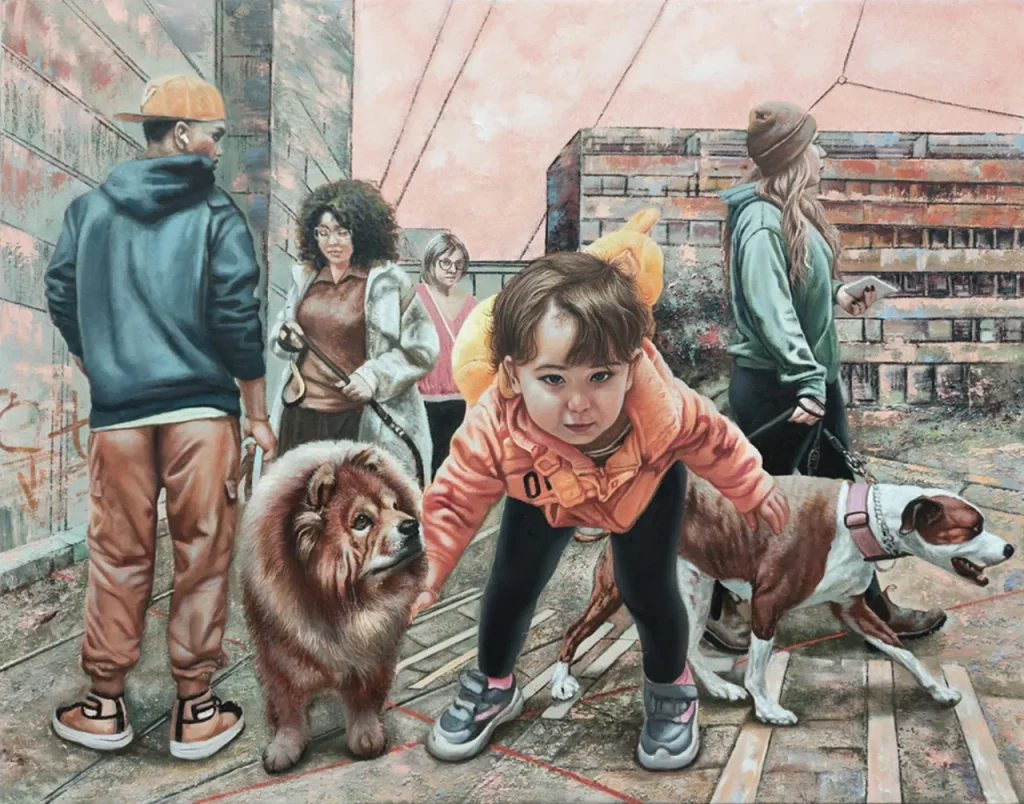
I grew up in a small city in Southwest China, where there were many military factories called the “Third Front,” established for China’s political needs at the time. Every factory gathered new immigrants from all over the country, speaking various accents. For me, that was a strange era full of curiosity and longing. The people who influenced me the most fall into two categories. One is the ordinary but artistically talented and resilient adults around me. They could compose music, sing, paint, dance, and were good at various sports. Daily life consisted of watching literary performances, local operas, sports events, movies, and attending dances. This was the lifestyle I experienced from childhood. It was a utopian small-city society with no gap between rich and poor and closed information—although no one was wealthy and resources were scarce, people often left their doors unlocked at night, maintaining kindness, dignity, compassion, and creativity. In those days, every household had more than two children. Apart from the parents working, the children automatically formed small circles of friends based on where they lived. The adults were optimistic, resilient, and kind, and the children were treated gently and looked after by different families.
This subtly shaped my character and directly laid the foundation for my artistic concept of “guarding the warmth of humanity with a brush,” making me always believe that the core of art is “people”—real emotions and vivid vitality, rather than grand forms. The other category consists of predecessors in the art world, such as those creators who adhere to classical realistic techniques and do not cater to trends. They made me more certain of my artistic direction: the value of art lies not in showing off skills or following trends, but in sincerity and persistence. This has also become my unchanging creative creed for many years. At the same time, some scholars focusing on the humanities and history have also taught me to integrate deeper thinking into my creations, so that my works have not only realistic beauty but also spiritual weight, practicing my artistic pursuit of “figurative carrying the spirit, realism conveying depth.”
Do you see painting is a form of self-exploration, communication, or both? What desire are you trying to answer through your painting?
For me, painting is necessarily a combination of self-exploration and communication; the two are inseparable. This is deeply integrated into my artistic philosophy: I have always believed that the essence of artistic creation is “questioning inward, conveying outward”—exploring one’s own understanding of humanity and the world internally, and transmitting the truth and warmth one upholds externally. The process of creation itself is an inward self-questioning and the process of practicing my artistic philosophy. While depicting characters and capturing light and shadow, I constantly examine my own heart and organize my understanding of human nature and the world, adhering to the principle of “not simplifying complexity and not beautifying reality.”
This is the process of self-exploration. The finished work is my medium of communication with the viewer, which fits my expressive philosophy that “silence speaks louder than words”: I do not deliberately instill viewpoints; I simply present the truth I see and feel with restrained, realistic brushstrokes, allowing the viewer to find resonance in the image. This is a silent but powerful communication. What I try to answer through painting is actually a very simple question, which is also the core pursuit of my artistic philosophy: in this noisy, impetuous, and uncertain world, how can the dignity, kindness, and hope of individuals be seen and protected? Painting is the answer I provide.
“Through the lens of a woman’s perspective, I reflect on the complex tapestry of war, history, and human nature, aiming to reconstruct the coherence of meaning in a fragmented reality.”
Liao Wanning
As a contemporary artist, how do you balance traditional portraiture techniques with the modern desire to show a “fragmented” or “evolving” self?
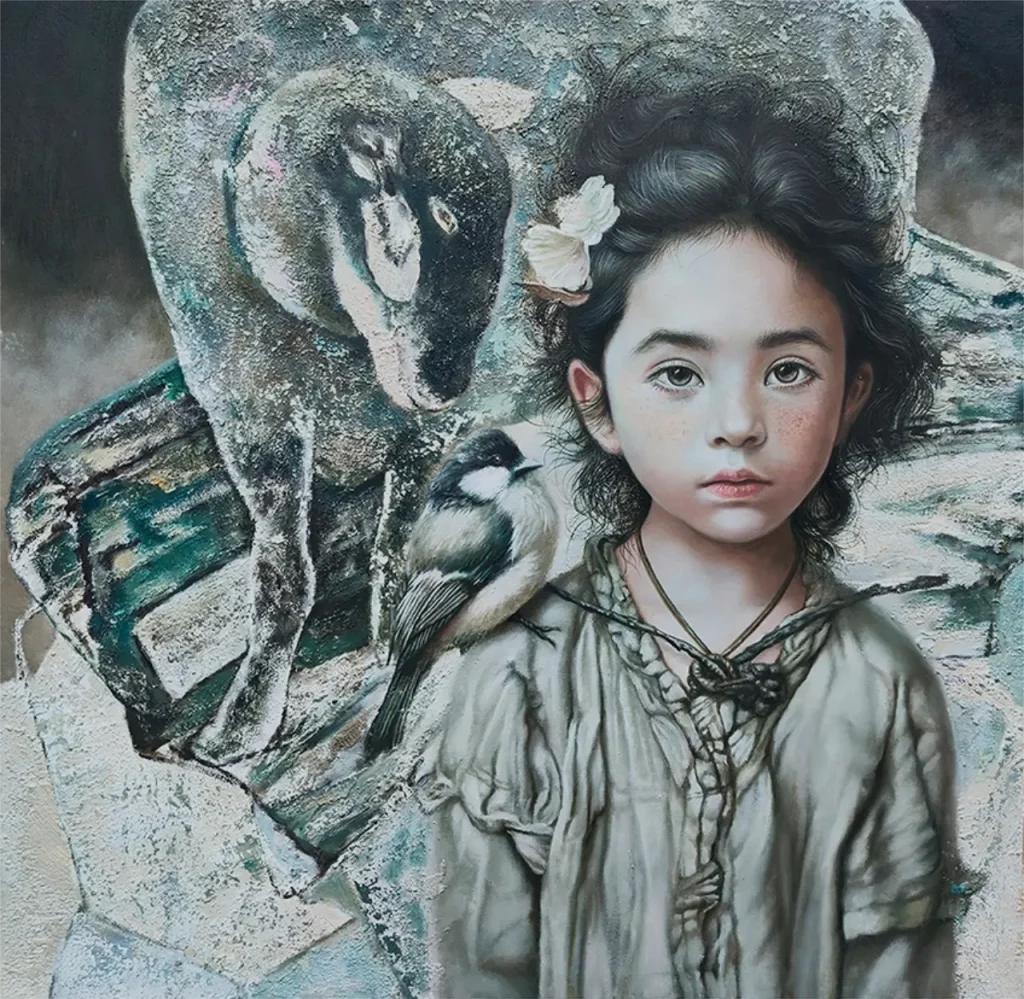
For me, traditional portraiture technique is the “root,” and showing the “fragmentation” and “evolution” of the modern self is the “soul.” The key to balancing the two lies in “not separating and not blindly following,” which is also one of my core artistic concepts—tradition as the foundation, contemporary as the soul, and realism as the bridge, letting classical techniques become a carrier for responding to contemporary emotions and carrying modern thoughts. I always take classical realistic techniques as the foundation, adhering to traditional techniques such as multi-layer glazing and chiaroscuro to preserve the texture and warmth of painting. This is both the confidence of my creation and the manifestation of “respecting the essence of painting.” I have always believed that realism is not a rigid replication, but a restoration full of temperature and thought.
When showing the evolution of the modern self, I do not deliberately pursue formal “fragmentation.” This fits my artistic philosophy of “restrained expression”—not deliberately changing the visual form to cater to modern trends, but hiding inner changes and the marks of the times within the brushstrokes, colors, and expressions of the characters. For example, I use traditional techniques to depict the state and situation of contemporary people, capturing the complex emotions within characters with delicate brushwork, making traditional techniques a carrier for carrying the modern self and responding to contemporary emotions. This makes tradition contain warmth and allows the modern to have roots, both adhering to the essence of realism and endowing the work with a contemporary spirit. This has been the creative direction I have adhered to for many years.
It seems that you use color not just to represent light, but to create a specific internal temperature. What role does erasure or revision instinctively color play in your artwork?
You are absolutely right; this is precisely the core concept of my use of color—color serves emotion and empowers temperature. It is by no means a simple tool for representing light, but a carrier for conveying inner temperature and expressing emotion; it is an indispensable element in my realistic expression. I always adhere to “restrained use of color,” not pursuing intense color impact. Low-saturation tones can create a quiet atmosphere, and subtle color changes can convey the ripples in a character’s heart. Every choice of color is made to fit the emotion of the image and the inner temperature, which also aligns with my overall artistic philosophy of “sincerity and restraint.”
The act of erasing and modifying color is not “error correction” for me, but a process of “approaching the truth.” It is an instinctive dialogue with the image and a manifestation of my practice of the “extreme realism, extreme sincerity” philosophy. Many times, the initial color combination may only be my preliminary imagination of the image. During the creative process, as my understanding of the characters and emotions deepens, I will adjust the shade, coolness, and warmth of the colors through erasing and modifying until the color can both fit the truth of the light and accurately convey the inner temperature I want, making color, emotion, and truth fit perfectly. This kind of modification is actually a process of constantly questioning inward to give the image more soul, and it is my adherence to the idea that “every work must carry truth and warmth.”
In her recent works, she has focused on the global issue of the Russia-Ukraine conflict. Through over 100 pieces, she uses the Ukrainian flag as a visual symbol, combining symbolic and imagery to highlight how war erodes the boundaries of humanity and perpetuates the cycle of historical violence.
In some of your works, shadows seem to hold as much important weight as the subjects themselves. Do you view shadow as an absence of light, or as a container for things that are not said out loud?
I have always believed that shadow is definitely not the absence of light, but the “other half of the soul” of the image, a container carrying unspoken things. This is integrated into my artistic philosophy of “realism is not superficial, details hide deep meanings.” I insist on realistic creation, but I am never limited to “replicating appearances.” Instead, I focus on conveying deep emotions and stories through details. Shadow is my most commonly used “silent language.” In portraits, the subject’s expression and outline are the “visible truth,” while the shadow is the “unutterable emotion and story.” This also fits my creative principle of “restrained expression and leaving space to convey meaning.”
For example, the shadow on a character’s face not only makes the outline more three-dimensional but also captures the hidden emotions in the character’s heart—perhaps a hint of stillness, a touch of tenderness, or a trace of imperceptible melancholy. The shadow in the background can create an atmosphere and set a foreshadowing, making the image more layered and leaving more space for the viewer’s imagination. Those unspoken emotions, untold stories, and the parts deep in the character’s heart that are not easily shown can all be hidden in the shadows, giving the image not only “form” but also “spirit,” and giving the silent image a longer-lasting power. This is also my deep understanding of “realistic art”: realism is about restoring truth, and even more about conveying the soul behind the truth.
Every artist encounters a moment where a painting feels like it’s failing. How have you distinguished between a piece that needs more work and a piece that told you it wants to be something else entirely?
This distinction stems from my judgment of the “essence of the image,” and even more from the artistic philosophy I have adhered to for many years: the core of a work lies in emotion and the inner essence, not in technique and form. I have always believed that in an excellent realistic work, technique serves the inner essence; technique without an inner essence, no matter how exquisite, is just empty showmanship. If I can clearly feel that the inner essence of a work is clear and the emotion is real, and there are only flaws in technique, color, or composition—such as the color not fitting the emotion well enough or the brushwork not being delicate enough—then it only needs more modification. I will patiently polish and adjust it, approaching my original vision bit by bit.
This is precisely the manifestation of my “extreme pursuit of truth and warmth.” But if, after repeated modifications and adjustments, I still feel that its inner essence is blurred and the emotion is empty, and even the most exquisite technique cannot convey the truth and warmth I want, then I will realize that it itself wants to become something completely different. At this time, I will not force my persistence but will stop and listen to the “voice” of the image, either completely overturning and repainting it or extracting the valuable parts and transforming them into inspiration for another work. This is also part of my artistic philosophy: artistic creation should not be “stubborn persistence,” but “sincere compromise and rebirth.” Respecting the work itself is respecting the essence of art and my original intention of “using the brush to convey the truth.”
You capture the completeness of the beauty: authenticity over aesthetics in a world that often demands women to be ‘curated’. Is your commitment to realistic, unvarnished portraiture, an act of giving women the right to be seen exactly as they are? How do you protect your creative voice in an art market that favors trends?
Liao Wanning: Yes, this is exactly the original intention of my insistence on realistic and unembellished portraits, and it deeply resonates with my core artistic philosophy that “truth is beauty, sincerity is power.” I have always believed that art should not be a “filter” used to beautify falsehood and avoid reality, especially in portraiture; its value lies not in depicting a “perfect appearance,” but in capturing a “truthful soul.” As realist artists have shown, they reproduce external objects through observation and depiction, experiencing their own feelings and understanding. Such art conforms to the viewer’s visual experience and provides sensory aesthetic pleasure. In this era of excessive pursuit of “perfection” and “exquisite packaging,” many people are used to hiding their true selves, especially women, who are often required to conform to certain established aesthetic standards.
What I want to do is use the brush to “restore the truth”—this is also the core pursuit of my realistic creation: no beautification, no embellishment, capturing the most authentic expression and natural state of women. Even the fine lines on the face or the fatigue in the eyes are part of their unique charm and part of beauty. I hope through such creation to empower women to show their true selves, and I want to convey my artistic claim: truth is the most powerful and complete beauty; the mission of art is to protect this truth and convey this unembellished human warmth, breaking people’s stereotypical perceptions of “beauty.” This is the original intention I have adhered to for many years. As for how to defend my creative philosophy in an art market that worships trends, my method is simple—”guard my heart, do not follow blindly, and do not cater.” This is the most steadfast part of my artistic philosophy: art should not cater to the market but should lead aesthetics and convey power. I always believe that the value of art does not lie in whether it closely follows trends, but in whether it is sincere, whether it has temperature, and whether it can convey power.
Realism is the best way for me to convey this sincerity and temperature. Market trends change constantly, but human truth, kindness, and dignity are eternal themes and the eternal core of my creation. I will not change my realistic direction because the market likes a certain avant-garde style; nor will I waver in my original intention because someone questions my realistic style as “not avant-garde enough.” I always adhere to the principles of “restrained expression and realistic transmission of the soul,” avoiding showmanship and impetuousness, focusing on depicting what I think and feel, and insisting on using sincere brushstrokes to convey warmth and realistic images to carry thought. I firmly believe that time will prove that such soulful, warm, and persistent works have their own irreplaceable value. This is my reverence for art and my adherence to my own creative philosophy.

In your artistic career, is there a work that you feel particularly connected to, or one that represents an important milestone on your life or artistic path? Can you share the creative story behind this work and its personal significance to you?
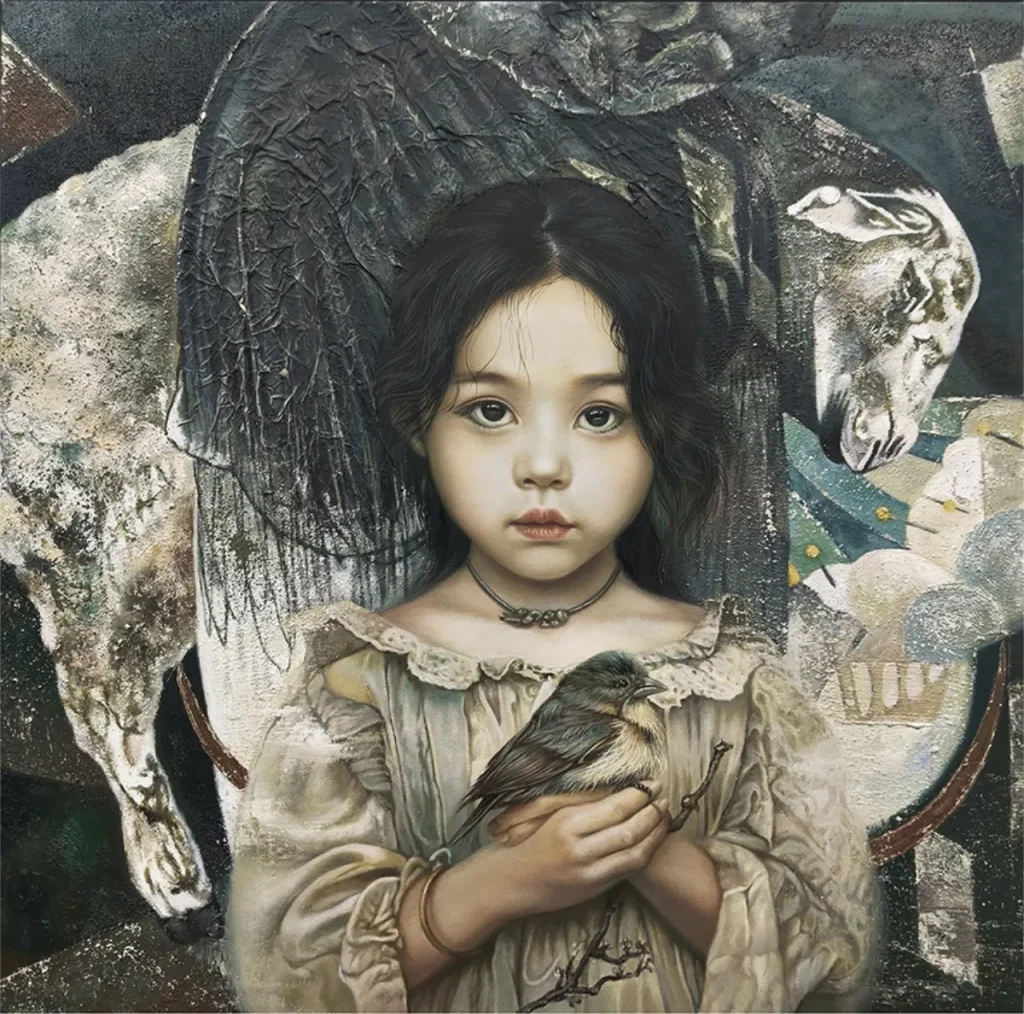
For me, the work that resonates most and marks an important shift in my artistic practice is Returning to Canaan. This work not only became a key turning point in my creative career but also vividly demonstrated my mature core artistic philosophy—using realism as a boat, sincerity as the soul, and symbolism as a bridge to guard the realm of truth, convey the light of hope, and pursue a spiritual home. The creation of this work originated from a period of inner confusion—at that time, the art market was swept by various avant-garde and trendy styles, and many people advised me to go with the flow, saying my realistic style was “outdated.” I once fell into self-doubt, struggling in the whirlpool of whether to change my creative direction and betray my original intention of “transmitting the soul through realism and sincere expression.” Just then, I witnessed many people who were in difficulty but still adhered to kindness and longed for belonging.
Their stories were like a beam of light that illuminated me, making me re-examine my original creative intention and strengthening my artistic philosophy: the value of art lies not in the formal innovation, but in the sincerity and power of the content. I gave up the idea of following the crowd, settled down, and used classical realistic techniques as a foundation to depict a girl holding a bird—this is precisely the practice of my “integration of traditional techniques and contemporary concepts”: using the classical multi-layer glazing technique to restore the delicate texture of the character and the bird, guarding the essence of realism; and using the symbolic imagery of the girl and the bird to convey the pursuit of a spiritual home and hope by contemporary people in turbulence and confusion, endowing the work with a contemporary spirit. With the girl’s steadfastness and the bird’s tenderness, I convey an understanding of human nature and a persistence in hope. This fits my philosophy of “restrained expression and silent transmission of meaning”—no need to deliberately render emotions; the image itself contains power. The creative process of this work was also a journey of self-redemption and self-solidification—it made me understand that creation is not about catering to the market, but about guarding the truth and conveying hope, and about using realistic brushstrokes to build a bridge between reality and the spirit. After this work was completed, it not only won the resonance of many viewers but also completely solidified my creative philosophy: no matter how the market changes, I will adhere to realism and sincerity, using the brush to convey human warmth and using works to carry spiritual weight. This has also become the core guide for all my subsequent creations.
As a painter navigating the contemporary art world, what does International Women’s Day mean to you personally and professionally? In your experience, how has being a woman shaped your path in the arts, in terms of challenges or expectations, and what changes would you like to see for women artists today?
For me, International Women’s Day is not only a tribute to female power but also a reminder of my original creative intention—it inspires me to continue using the brush to capture the truth and resilience of women and to defend their dignity and power. This aligns with the core of my artistic philosophy: speaking for women through realistic brushwork and guarding the truth of women through sincere expression. Just as Frida Kahlo explored the meaning of art and life through self-portraits, and Mary Cassatt depicted the depth of female emotions through domestic scenes, their works not only show the achievements of female artists but also reflect the status and identity of women in society. I have always believed that the beauty of women does not lie in “exquisite packaging,” but in truth and resilience, and art should become the “guardian” of this truth. In my professional career, this holiday constantly reminds me that as a female artist, I must not only do my own creation well and adhere to the principle of “realism without embellishment, sincerity without blind following,” but I also have the responsibility to speak for women through my works, convey female power, let more people see the light of women, and break people’s stereotypical perceptions of women.
This is also the mission I have always adhered to in my creation and an extension of my artistic philosophy: art is not only self-expression but also humanistic care and respect and protection for human nature and the individual. The challenges faced as a woman on the artistic path are very real: on the one hand, there are still some implicit biases in the art world. For example, some people think that the works of female artists are “not powerful enough” or “too delicate,” and will even use “feminized” to partially define our creations—this is precisely contrary to my artistic philosophy. I always believe that the power of art does not lie in the hardness of the brushstrokes or the avant-garde form, but in the sincerity and temperature of the core. The sensitivity of women can instead better capture the glimmer of human nature and better convey the “realistic soul” philosophy I uphold. On the other hand, women often have to balance family and career, facing more tests in terms of creative time and energy distribution. Sometimes, due to various trivial matters, I have to pause my creative plans, which makes me cherish every creative opportunity more and strengthens my belief in “keeping the original intention and not giving up creation.” My expectations are simple: first, I hope to have more time and space to focus on my creation, adhere to the “realistic and sincere” artistic philosophy, and paint more touching works; second, I hope to break people’s prejudice against female artists through my own efforts, so that everyone can focus on the work itself and the truth and warmth it conveys, rather than the artist’s gender. This is also my small hope for the art world as a female artist and my adherence to my own artistic philosophy. I even more hope for several changes in the situation of today’s female artists: First, break gender bias, so that female artists and male artists can enjoy equal display opportunities, recognition, and respect, no longer bound by gender labels, so the public understands that the value of art ultimately lies in the core and power of the work, not the artist’s gender.
This can also allow more female artists to bravely adhere to their own creative philosophy without following blindly or catering. Second, have more platforms and support to help female artists solve creative dilemmas such as time, funding, and display channels, so we can adhere to the artistic path with more peace of mind and focus on creation itself and the transmission of artistic philosophy and humanistic care. Third, I hope for more mutual assistance and inclusiveness among female artists, supporting and achieving each other, and jointly making a stronger voice so that more people can see the power and value of female art and see the human warmth and spiritual power we convey through realistic, sincere, and restrained expression. Regardless of gender, an artist’s value ultimately speaks through their work. I hope all female artists can bravely be themselves and adhere to their original creative intention, like me, taking realism as the carrier and sincerity as the core, blooming their own light, and letting art become a force that guards truth and conveys hope.
Photo and Images courtesy of Liao Wanning
Post Author