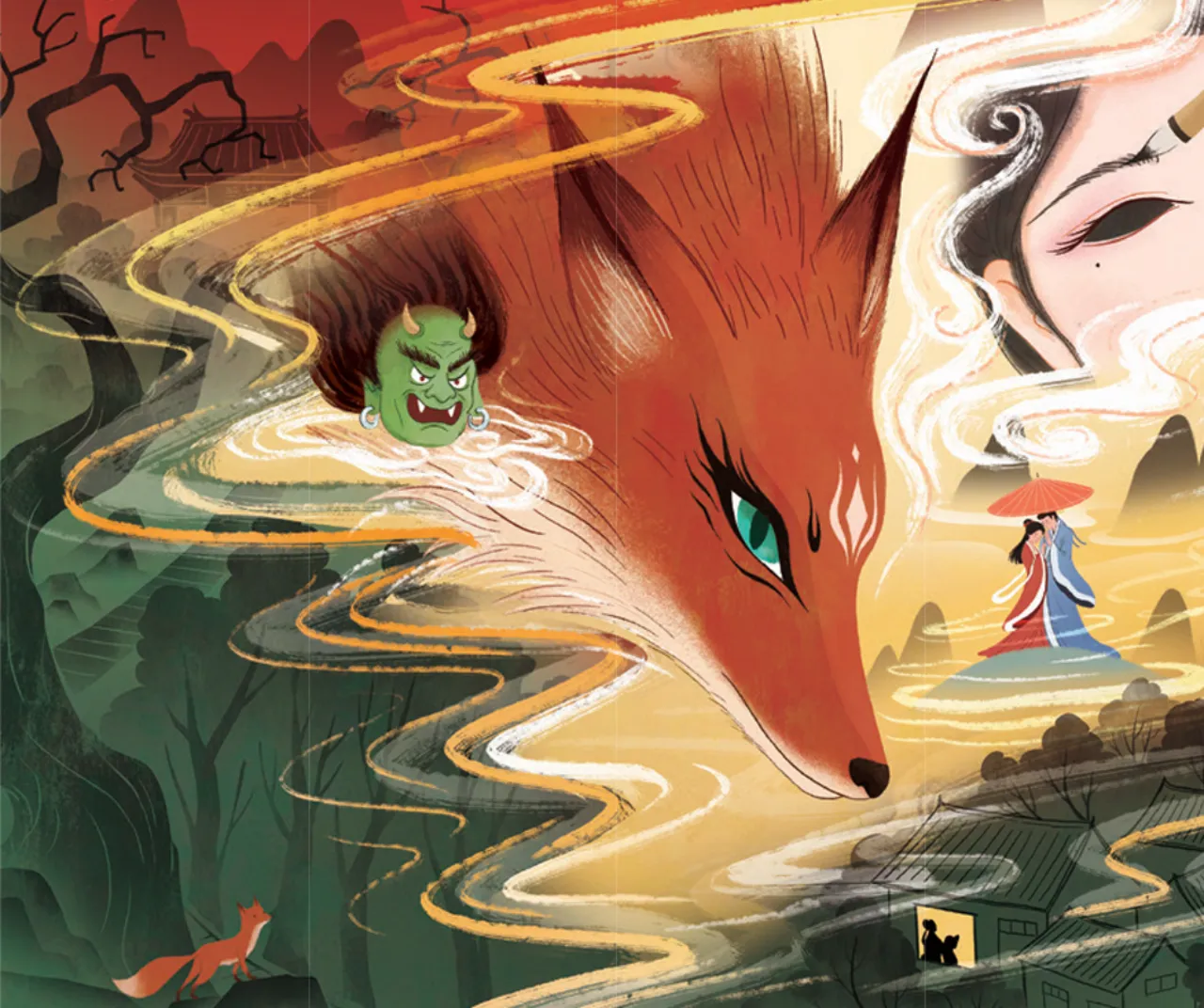
Susan Wan Dolling on female characters, Confucian constraints and a writer on their side
Pu Songling (蒲松齡) passed the first level of the Imperial Exams at eighteen and failed the next for most of the rest of his life. The seventeenth-century collection that carries his name, Liaozhai Zhiyi (聊齋誌異), came out under a title of his own devising and a signature to match: Mr. Historian of the Strange. Its tales run from one-sentence notes on natural phenomena to folk stories, cautionary tales and social satire. Failed scholars turn up throughout.
Stories from Mr. Historian of the Strange, published by Earnshaw Books in July 2026, gathers thirty-six of them under three headings: Favor and Gratitude, Reap What You Sow, and Dreams and Obsessions. The translator, Susan Wan Dolling, was born in Hong Kong and took her PhD in Comparative Literature at Princeton. She met the stories first through her mother, who told them to her and her siblings, and whose battered copy of the Liaozhai travelled from Shanghai to Hong Kong to Toronto. The translations took over thirty years, intermittently and with no plan at first. What made the cut followed her own familiarity with the tales, their popularity among Chinese readers and her mother’s repertoire; the stories of social injustice and corruption stayed out.
Laura Gibbs, whose own Aesop’s Fables appeared in Oxford World Classics, credits the thematic arrangement, the notes and the commentary with making the book truly accessible to English-language readers. Dolling’s English keeps Pu’s economy, saying much with little. Her memoir Inch-Tall Grass, which tells her mother’s story, is next.
Dolling has spoken to China Underground before, about her Tang poetry volume Floating on Clouds and about the literary legacy of the Tang dynasty. Here she talks about her mother’s storytelling, the wordplay that does not survive translation, and a second volume she has not yet committed to.
Susan Wan Dolling’s official site
Your mother read the Liaozhai as a little girl, “picking out the tiny characters one by one with a toothpick,” and her copy followed her from Shanghai to Hong Kong and then to Toronto. Today it sits on your bookcase. What does it mean to you to put your own translation on the same shelf?
Actually, I didn’t put my translations on the same shelf because her tattered copy with its gaudy cover has been taken off the shelf and grouped with the stack of Liaozhai copies I have since accrued, some I have worked with and others consulted, still others were bought by mistake, especially the retold ones, and then there were ones that have since been returned to the library. I wish I still had the cover of the old copy, but though I remember it vividly and described it in my “Preamble” in Mr. Historian of the Strange, it has since been lost as it was only hanging on by a literal thread even when I recovered it from my mother’s bedside table. I do know what you mean though and I will proudly display my translations by her coverless copy next time I tidy up my shelves. When I said my purchases of the “retold” tales were a mistake, by the way, I simply mean there is a great difference between the retelling of these stories and the original stories themselves, because the way Pu Songling told the stories adds so much to the experience. Translators can only do their best to follow the example of his genius and reenact as best they can in their own language what he has done in his classical Chinese. Here are a few snippets of my translated passages that succeed in some small way in bringing across his deftly executed prose, saying much with little and so imperceptibly:
1) Describing a young girl’s beauty in terms of movement and air:
The girl moved with the elegance of green willows in a gentle breeze and her eyes sparkled like fresh autumn waves. She possessed a beauty that exuded exquisite intelligence, a beauty beyond mere mortals. [from “A Family of Foxes”]
2) Parental advise that goes beyond cliché:
“ . . . in accepting someone’s appreciation you agree to share in his grief, in accepting someone’s favor you agree to take on his plight. Rich people repay others with their wealth; poor people repay with their loyalty. No good will come of taking a gift for no reason. For a large gift like this, son, I’m afraid you may have to repay with your life someday. . . .” [from “A Mother’s Advice”]
3) Trippingly summing up a situation, subtly warning that there will be consequences:
“One day, a young man came by the studio asking for a painting. He was very attractive but rather too casual in his ways. When Gu asked where he lived, he said he came from a nearby village. From then on, he came round every two or three days and gradually they became familiar, joking and horsing around, and even when Gu caught the young man in his arms, he did not protest; intimacy followed. [from “Lady Knight”]

She spoke of Pu Songling in Cantonese as if he were a family friend who dropped by for a sleepover. Do you remember a particular story she told you, and how did her spoken version compare with what you found when you finally read the classical text?
I particularly like this question because even though my interest in the Liaozhai was first provoked by my mother telling them to me and my siblings, when I started reading them for myself in Pu Songling’s inimitable classical Chinese, I realized how different they were in his telling and that was partly why I felt compelled to translate them in the first place. Of course, as I admitted in my Preamble, what I have selected for this volume from the 500 odd tales in Pu’s 17th-century collection is very much biased, depending on my familiarity with them, their popularity among the Chinese (some of these stories have been retold in comics and modern Chinese, movies and tv series among other venues) and my mother’s choices as our storyteller. Moreover, this particular volume of mine is the work of over thirty years, though not continuously, and at first, with no particular purpose in mind. While I was putting them together in the last decade, however, I had also started writing and re-writing my mother’s own story, now a hybrid memoir called Inch-Tall Grass, and in conjuring up her ghost, I would often spot Pu Songling somewhere in my remembrance of her. That was when I realized the significance of his stories to her, particularly the ones I ended up including in my hybrid memoir.
Now to answer your question and to go back to why I found retellings (and some unhappy translations) of the Liaozhai unsatisfactory when I finally read the classical text for myself. My mother often privately boasted to us, her children, that her Chinese prose was so fluent and superior because of her thorough reading of the Liaozhai. I was therefore not surprised at Pu’s mastery of classical Chinese, particularly with how efficient and expressive this concise language became in his hand; not surprised but totally overcome with admiration. Secondly, in my mother’s retelling of the stories, depending on the occasion and context, she might have chosen to emphasize certain parts and leave out others, so that she appropriated the stories for her own purposes. Moreover, the fact of the matter is that the Liaozhai stories are not always PG-13 material. Indeed one of the things that I came to admire about Pu’s storytelling is how straightforward and un-salacious his handling of sexual matters was.
I would direct you to Inch-Tall Grass for the answer to the part of your question about what story she told me, because those stories are so intimately entangled with the why and the how of our lives that to answer it here would be to forecast too much of what’s coming next.


In the acknowledgements you date a revelation precisely: February 11, 2017, your mother’s 97th birthday, after a party in her memory. What happened that day, and how did it bring order to material you had kept “in the attic” since your undergraduate years?
You are such a perceptive reader that you are anticipating my responses in the next book again! Let me quote the first paragraph in the Prologue to Inch-Tall Grass in answer:
“One day near the end of 2016, the Year of the Monkey, I decided to go over some photos my mother gave me before she died. It was then that I came across an old Chinese magazine cover, one of those tabloid-type colorful periodicals full of stories about Chinese stars and Hong Kong movie news. The cover was folded in half. When I opened it I discovered that pasted on the inside were eight or nine photos of her. On closer scrutiny, each photo was taken about ten years apart. I realized then that it was a sort of diary, a summary of her life’s journey. Looking at the yellowing photos of my mother as she aged I was moved, once again, to capture my memories of her. I had tried on and off, both before and after her death in 2008 to tell her story in a variety of ways, but, for one reason or another, I was never able to complete the task.”
Once I started writing, it was like a haunting and I wrote and wrote and rewrote until the memoir was done, on my own birthday as it happened; but that was only the first draft. Since then, it has undergone much more tailoring. Mr. Historian came out of the attic at the same time, and additional work on this was done in tandem with everything else. So it wasn’t what happened on February 11, but what happened a few weeks before that, my coming upon her photographs, that brought on the flood of writing and collating which included the five volumes of Tang and Song poetry.
You suggest Pu invented these powerful female beings out of empathy for his mother and his wife, both held back by the society of their time. What in the stories persuaded you of this?
My mother too, though not to the extent of the women found in Pu’s feudal society in the Qing dynasty, was “held back” by her society, and on top of that, she was a super smart woman, so she must have recognized her own frustrations in these female characters and reveled in the superpowers Pu gave them so that they could break out of the constraints placed on them by their Confucian society. So it wasn’t in any one particular story that I find this to be the case but that all of them, each in their own way, and in the way he portrayed them, which convinces me that he was on their side. “Lady Knight” and “A Lady Friend” are two obvious examples.

Pu passed the first level of the Imperial Exams at eighteen and then failed the next level for almost the rest of his life. Failed scholars are everywhere in your selection, from “Death Doth Not Part” to “Fighting Crickets.” Do you read the collection partly as the consolation of a man the system rejected?
Yes. No doubt about it, but also with righteous indignation. In fact, scholars rich and poor, successful or failed, are in many of the stories in the entire selection.
You admit mixed feelings about Confucius because of how he treated women, yet he runs through the whole book, and Mr. Historian often judges in Confucian terms, as in “Filial Piety.” How do you translate a moral commentary you may not share?
As translator, I translate. My opinions and comments are expressed elsewhere, as you discovered.
Some wordplay just doesn’t survive. In “Keepsakes” you turned the liang pun (cool/good) into “gentle man” and “gentleman,” and you moved the “moth brows” from the antennae to the wings. How much freedom do you give yourself when the original can’t be carried over?
Fortunately for me, I am not often stumped, but you are right in that wordplay especially doesn’t always survive. When I do such sleights-of-hand as in the examples you cite here, however, I always confess.
As a child in Hong Kong you knew some of these stories from comics and films before you read them. Did those images get in the way of your translation, or help it?
Not particularly. At least, not that I am aware.
In her afterword, Laura Gibbs compares Mr. Historian with Boccaccio’s Decameron and Basile’s Pentameron. That makes an intriguing bridge for Italian readers. Do you see real kinship between Pu and those European storytellers, or mostly difference?
I asked Laura what she meant by that comparison and she said, “Mr. Historian is able to do both: the sexual hilarity of Boccaccio and the fabulous fairy-tale adventures of Basile.”
You left out more ghosts than foxes, preferred dreamscapes to the underworld, and set aside the stories of social injustice and corruption, which “might find their way into another book.” Is that second volume already taking shape?
I have not committed myself to a second volume yet because I’m still working on Inch-Tall Grass and another book of essays.
Could you also please share a couple of images with me for the layout of the article?
I believe you already have the cover of Mr. Historian from Graham, but you might choose one of these more colorful ones which has the authoritative 張友鶴 Zhang Youhe edition which I used for the translation with my books in the same photo.
Photos courtesy of Susan Wan Dolling
Post Author
