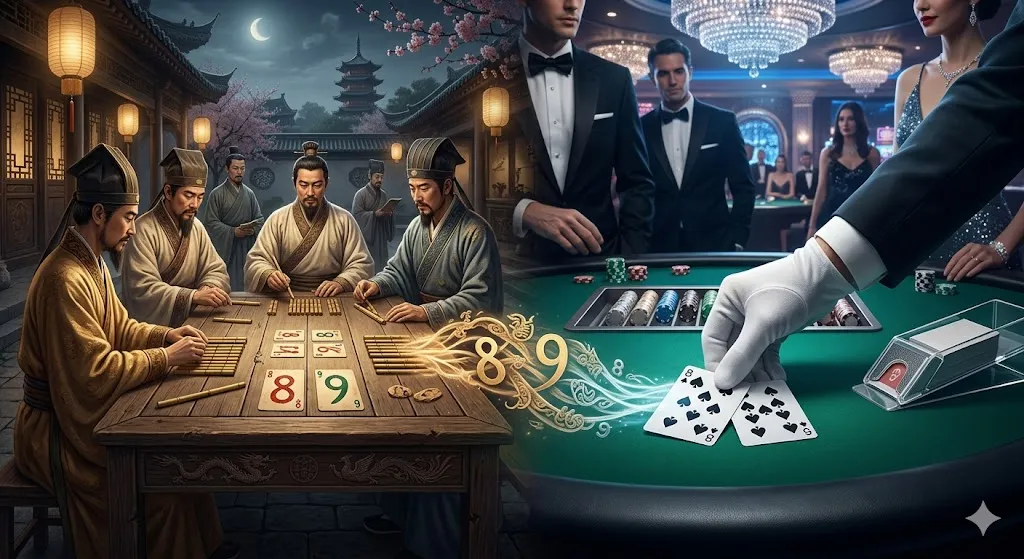
The sparkling chandeliers of Monaco. High-rollers tossing velvet ropes aside in Macau. James Bond casually shakes a cocktail whilst playing the tables against his opponent. This is the image we have of baccarat.
It’s slick. It’s European. It’s thoroughly modern.
Except, it might not be. Not at all.
The battle between Italy and France over being the birthplace of baccarat has been going on for decades. The Italians say that they were the first to make it in the 1400s using a deck of Tarot cards, by a man named Felix Falguierein. The French counter that soldiers returning from the Italian Wars brought home was the favorite of King Charles VIII. Both stories are well-crafted. They both match the style. Both fail to take into account a giant, glaring historical possibility – China.
It seems that the origins of the world’s largest casino game are not in the European salons. They extend east for thousands of miles, centuries before Falguierein was supposed to have set his Tarot cards. The connection goes beyond just theoretical – it is a structural connection.
The Nine-Point Connection: Pai Gow
In order to understand the Chinese connection, it helps to distill baccarat to its essence. Say goodbye to tuxedos and commission boxes. Mathematically speaking, what is baccarat? This is a game in which the maximum would be “9”. You add up the values, cross out the tens digit, and try to make that magic number.
Now, let’s move on to Pai Gow. Not the present-day game of poker, but the traditional Chinese tile game. The word Pai Gow means to make 9.
This is no accident.
The Chinese were fascinated by the number nine. It was the emperor’s number. The highest of the single digits. It was the most perfect. In Pai Gow, you arrange 32 domino-like tiles into two hands, and your goal—just like in baccarat—is to get a point total closest to nine.
The mathematical parallels are astounding. In both games, the players discard values of ten. The sum of 15 is reduced to 5. 18 changes to 8. This is a very unique modulo-10 arithmetic and is the crux of Pai Gow and baccarat. It’s a short hop from carving tiles to shuffling paper cards, if the underlying math is the same.
From Tiles to Paper: The Silk Road Catalyst
How did the ancient Chinese tile game become a card game in Renaissance Europe? The explanation is along the same lines as the introduction of silk, gunpowder, and porcelain to the Western world. The Silk Road.
The invention of playing cards in the late 13th century is traditionally attributed to Marco Polo. Although the details of Polo’s luggage vary among historians, the timeline fits. Paper money was invented in China. Not long thereafter, they created paper playing cards, probably during the Tang Dynasty (618-907 AD). These were early “money-suited” cards that were used to play games that were based on the same principles of Pai Gow.
These paper cards reached Venice via the Silk Road, along with the objects and the rules.
The Venetians had a keen love of gambling. They learned to take up foreign games and adapted them to their own tastes. The precursor games of baccarat are likely direct ancestors of the Chinese card games. The Italian term “baccara,” which translates as zero, is a reference to the game’s distinctive feature of face cards and tens being valued at zero, which is in direct contrast to the Pai Gow mechanic of discarding the tens.
The Italians were not the inventors of the mechanics. They repackaged them.
Macao: The Missing Link
If you need a smoking gun, look at the game “Macao.”
The game that preceded baccarat as the game of choice in the European casinos was called Macao, and it was popular in the 18th century. It was the forerunner to baccarat and blackjack. And how did you play Macao? You drew cards to get as close to a score of nine as possible.
It’s obvious from the name. Macau (or Macao) was the first European settlement in the Far East, established by the Portuguese in 1557. It mushroomed into a trading center and a location for the violent and profitable clash of Eastern and Western cultures. Card games were imported from the Portuguese colony, and literally named after the Chinese port city where they were first heard of.
The changes are evident. The early paper card games (Silk Road/Venice) -> Pai Gow (Chinese) -> Baccarat (Italian/French refinement) -> Macao (Portuguese traders).
The European aristocracy didn’t conjure the game out of thin air. They honed a game that had been spread across continents for centuries.
The Asian Dominance Makes Sense Now
This historical context helps to answer a question that has always baffled casino analysts: why is baccarat so unfathomably popular in Asia today?
Nearly 90% of Macau’s casino revenue is derived from baccarat. It is the most insignificant of all games. Even in Las Vegas, the high-limit rooms are dominated by Asian players dropping fortunes on the baccarat tables. When people choose to play baccarat online, the player base heavily skews toward Asian markets or those familiar with Asian gaming culture.
This is seen by Westerners as a cultural quirk. They point to superstition, the act of “squeezing” the cards, or a general preference for games of pure chance over skill.
But look deeper. It’s not a coincidence that baccarat resonates in Asia. It’s an echo.
This game is culturally relevant because its DNA is Chinese. Math, reverence for the number 9, structural pacing—it has all come from the same ancient roots as Pai Gow. When Asian players flock to the baccarat tables, they aren’t adopting a European game. They are helping to retrieve a game they started in their backyards. The French simply put a nice suit on it.
Beyond the Velvet Ropes
Baccarat’s story must be rewritten. It’s a very cute story about the Falguierein, but it’s a localized version of a much grander story of an evolution happening all across the world.
Games don’t exist in a vacuum. They travel. They mutate. They adjust themselves to the culture in which they live. Baccarat is the last survivor of the Silk Road. It withstood the transition from carved tiles to paper money-suits, to Tarot cards, to the standard 52-card deck that we are familiar with today.
The next time you notice the dealer shuffle a card over the felt, don’t pay attention to the French terms. Don’t pay attention to the “Banker” or “Player” designation. Look at the math. Notice the never-ending search for the number nine. You’re not viewing a product of the Italian Renaissance. You are witnessing a mathematical passion that originates in ancient China, has been developed over thousands of years, and has completely enslaved the world.
Post Author
